
A1 Highway to Palapye Tour | 5-Day
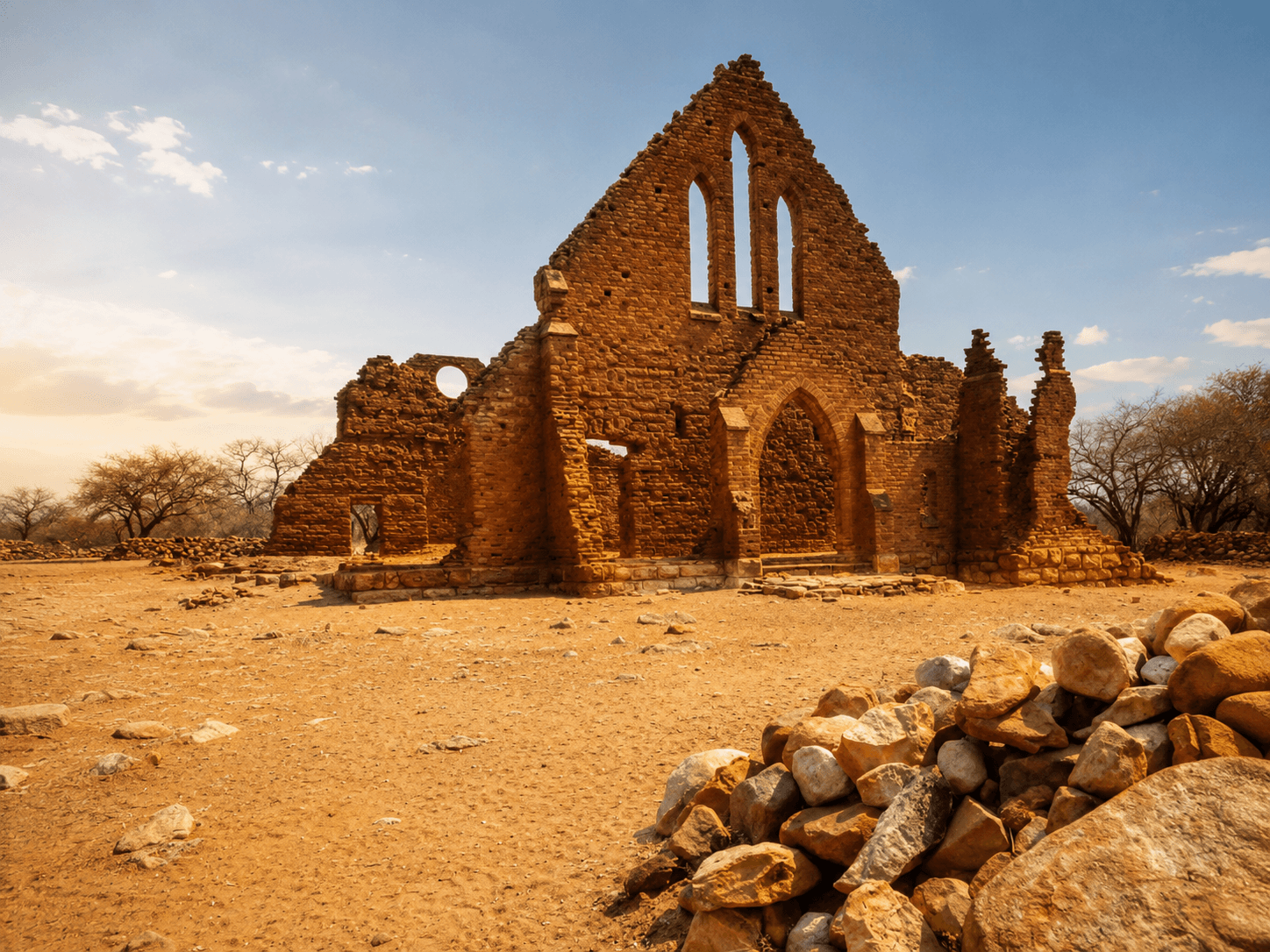
Travel Botswana’s historic heartland on the A1 Highway to Palapye Tour — a 5-day, 4-night road journey from Gaborone through Mochudi, Mahalapye, Old Palapye, Serowe, Khama Rhino Sanctuary, and the dramatic Goo-Moremi Gorge.
The Road Already Knows the Story. This Tour Lets You Hear It.
There is a version of Botswana that lives quietly inside the landscape.
Not in a game reserve. Not in a five-star lodge with a curated sunrise view. In a missionary stone wall that has been standing since 1891. In a baobab tree that once served as the meeting room, the marketplace, and the community notice board — long before any of those things had formal names. In a gorge that carries the kind of stillness that only comes from being very old and very undisturbed.
The A1 Highway to Palapye Tour follows that version of Botswana.
This is a 5-day, 4-night heritage road journey from Gaborone along one of the country’s most historically loaded corridors — through Mochudi, Mahalapye, Old Palapye, Serowe, the Khama Rhino Sanctuary, and the dramatic overnight finish at Goo-Moremi Gorge. Offered in partnership with Gifa’s Transport & “Cresta Mahalapye for your comfortable sleep”, and designed for small groups of 5 to 10 people, this tour is priced at USD $3,194.
It is not a rush. It is a reckoning with place.
What Makes This More Than Just a Road Trip
Most people have driven stretches of the A1 at some point. It is a familiar route — towns you know by name, signboards you have read without stopping, landscapes that blur into background on your way somewhere else.
This tour asks you to stop.
To walk into the places most itineraries skip. To read the walls, understand the trees, and let a museum photograph from 1896 hold your attention for longer than your phone screen usually gets.
The A1 Highway to Palapye Tour is built for people who travel with questions — the kind that cannot be answered from the passenger seat of a moving vehicle.
Tour at a Glance
| Detail | Information |
|---|---|
| Duration | 5 Days, 4 Nights |
| Group Size | 5 to 10 people |
| Price | USD $3,194 |
| Partners | Gifa’s Transport & “Cresta Mahalapye for your comfortable sleep”, |
| Departure Point | Gaborone |
| Accommodation Base | Mahalapye (primary), Goo-Moremi Gorge (final night) |
| Tour Focus | Heritage, culture, history, wildlife, natural landscapes |
Who This Tour Is Built For
History Travellers and Heritage Enthusiasts
Old ruins, colonial-era structures, archaeological finds, missionary history, exile stories, and railway lines — this route has all of it, and it does not feel like a textbook.
Schools, Universities, and Research Groups
The itinerary carries genuine academic weight. Archaeology, colonial history, settlement patterns, indigenous culture, railway development, exile politics — this is a moving classroom with exceptional source material.
Local Explorers
You do not need to be visiting from another country to find this valuable. Some of the most meaningful journeys are the ones that show you something new about the place you have always lived. Botswana’s own people deserve to know this history well.
Small Groups and Families
Five to ten people is the right size for a journey like this. Enough energy. Enough conversation. Not so many people that the experience becomes impersonal.
Stop by Stop: What the Route Uncovers
Mochudi — Education, Memory, and 50,000 Years in One Building
The tour opens in Mochudi, and it sets the tone immediately.
The Phuthadikobo Museum is not a casual walk-through exhibit. It is one of the first nine schools established in Botswana — a building that has served education and memory across different eras. Today, it holds photographic archives stretching back to 1896 and archaeological artefacts aged over 50,000 years.
That is not a typo. Fifty thousand years of human presence recorded in one place, in a building that was also a school, in a town that most travellers pass without stopping.
Mochudi establishes what the rest of the trip keeps confirming: Botswana’s heritage is deeper, older, and more layered than most people know. This is where the reintroduction begins.
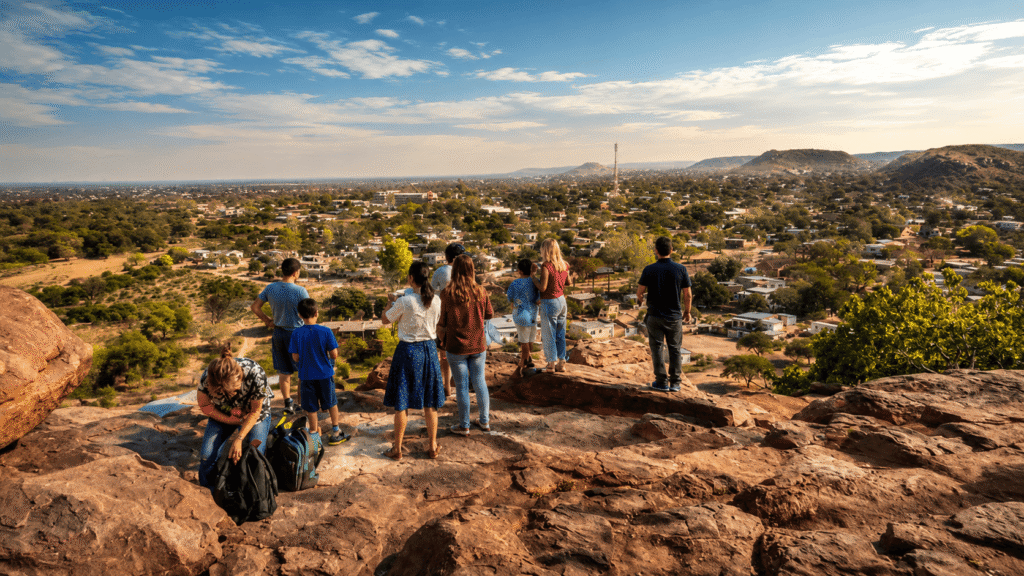
The Tropic of Capricorn — Twelve Pillars, Twelve Countries, One Line
There is something about standing on the Tropic of Capricorn in person that a map simply cannot communicate.
But this stop is more than just a geographic marker. Here, 12 pillars of unique columnar joint stones stand together, each one engraved with the name of a specific country that the Tropic of Capricorn passes through. It is a geographical and cultural pitstop that places Botswana in its full continental and global context — a reminder that this line of southern latitude connects nations, climates, and stories far beyond what any single country can contain.
On paper it is a coordinate. On the ground, with Botswana’s sky overhead and twelve stone pillars standing quietly in a row, it becomes a moment.
Someone in the group will insist everyone stands beside a pillar for a photo. That person is providing a service. Cooperate.


Mahalapye — A Baobab, an Airstrip, and One of the Most Heartbreaking Love Stories in Botswana’s History
Mahalapye arrives with more stories than most towns its size have any right to carry — and it carries them all with quiet dignity.
The Baobab That Predates Infrastructure
A giant baobab tree here was used for generations as a gathering place, an engagement venue, a community meeting point, and an open-air marketplace — long before any of those things had buildings attached to them. Before formal governance and modern infrastructure, this tree was the centre of public life.
That is worth standing under for a moment. Some institutions do not have walls. Some of the most important spaces in a community’s history are simply shade.
The Airstrip and the Exile of Seretse Khama
Then there is the airstrip.
It is not the airstrip itself that makes this stop significant. It is what happened beside it. This is where Lady Ruth Williams Khama stood and waved at a plane flying overhead — carrying her husband, the future President of Botswana, Sir Seretse Khama, who had been exiled by British colonial authorities.
The story of Seretse and Ruth Khama is one of love, race, politics, and colonial interference at its most personal and most brutal. Their marriage — a Motswana man and a British woman — so unsettled the British government and apartheid-era South Africa that exile became their instrument. She stayed. She waved. He eventually came home, and led the nation.
That airstrip now sits quietly in Mahalapye. But knowing what it witnessed, it is impossible to look at it the same way.
The 1897 Railway Line
Mahalapye also holds the history of a British railway line built in 1897, constructed to connect South Africa to Rhodesia — the country known today as Zimbabwe. The line was part of the broader colonial infrastructure project that reshaped trade, movement, and settlement across the region. Transport routes are never simply practical. They are statements of power. They tell you who was going where, who decided, and who the journey was really built for.
Mahalapye serves as the primary accommodation base for the tour — a fitting place to rest when the day’s stories have been this heavy and this rich.
Old Palapye — Walls That Outlasted the People Who Built Them
If there is a single stop on this tour that demands the most from you, it is Old Palapye.
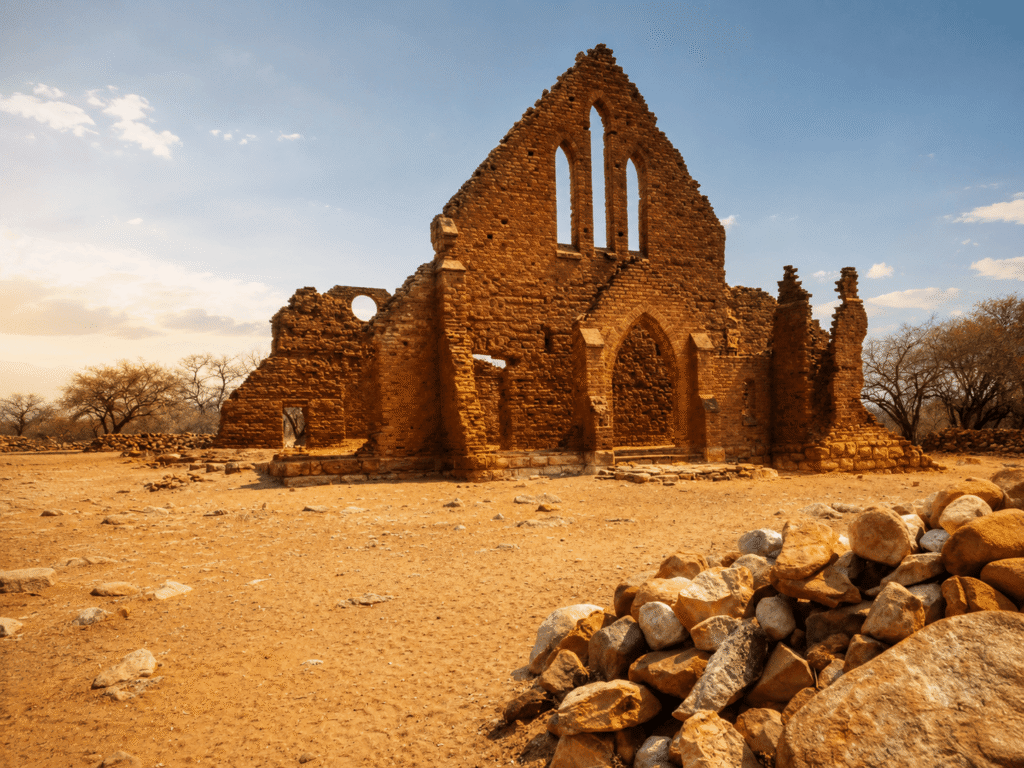
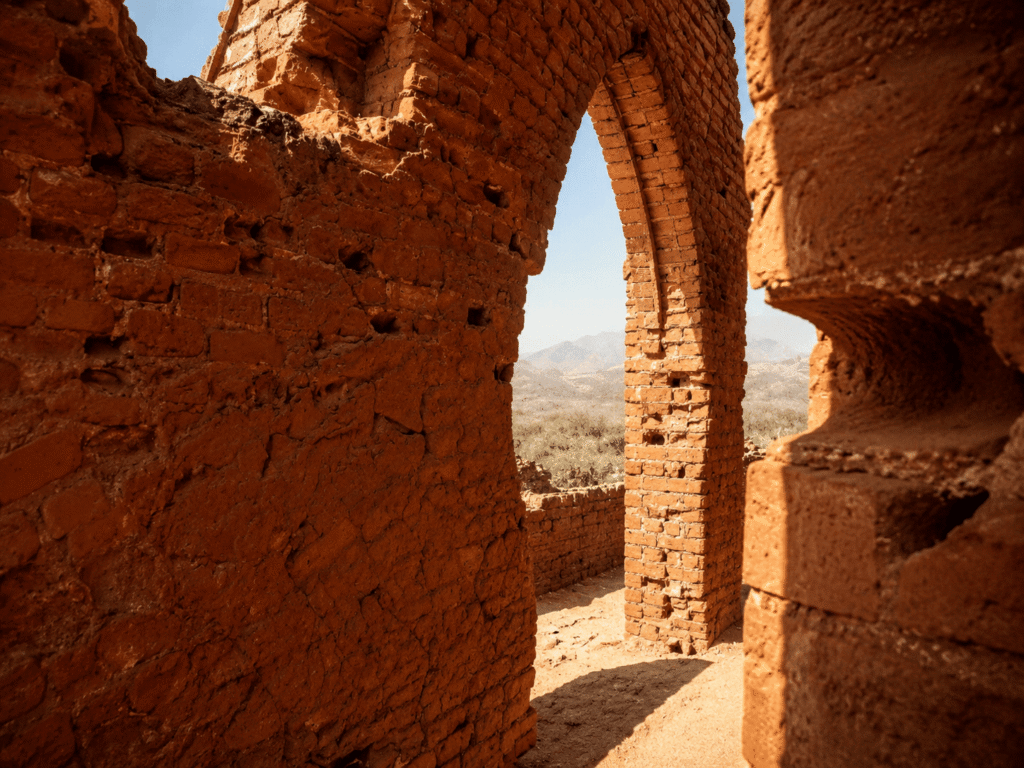
The London Missionary Society structure, built between 1891 and 1894, still stands — gothic-style stone walls rising in a place that time has otherwise reclaimed. Around it, the ground holds the remains of traditional rondavels, old civil structures, traces of a 19th-century prison, and the graves of early European settlers.
This is not a reconstructed heritage site with informational placards and a gift shop. It is the real thing — quiet, weathered, and layered.
Walking through Old Palapye asks something of the visitor. It asks you to look at what remains and try to fill in what is missing. Architecture, faith, community, conflict — all of it was here. Some of it is still visible if you slow down enough to look properly.
Serowe and the Khama Rhino Sanctuary — History Meets Conservation
Serowe is one of Botswana’s most historically significant towns, deeply connected to the Bangwato people and central to some of the most important chapters in the country’s pre-independence story. Arriving here after Old Palapye feels like the narrative is building toward something — and it is.
From Serowe, the tour moves to the Khama Rhino Sanctuary, a conservation landmark that adds a completely different dimension to the journey. After days of ruins, museums, railway lines, and colonial history, the sanctuary offers the living, breathing side of Botswana’s heritage story: the communities and landscapes still worth protecting.
The Khama Rhino Sanctuary is not just a wildlife stop. It is a community-led conservation success, and that context matters. It fits the spirit of this tour entirely — because this has always been about understanding Botswana fully, not partially.
Goo-Moremi Gorge — The Final Night, and the Best Kind of Ending
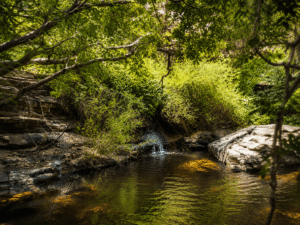
The tour closes at Goo-Moremi Gorge for the fourth and final night — and it is an ending that earns its place.
After five days of history, stone walls, exile stories, ancient trees, railway lines, and rhino sightings, the gorge offers something different: dramatic natural scenery, a spiritual atmosphere, and the particular silence that only comes from sleeping somewhere that has been undisturbed for a very long time.
Some places do not need historical context to be significant. Goo-Moremi Gorge is one of them. Its significance is written into the rock itself.
It is the right place to end a journey like this — somewhere that asks nothing of you except to be present.
Why This Tour Is Worth the Investment
The A1 Highway to Palapye Tour does something that is harder to find than it sounds: it makes a familiar road unfamiliar again.
These places have always been there. Mochudi. Mahalapye. Palapye. Serowe. The difference is what happens when you arrive with the right questions, the right guide, the right amount of time — and the full story of what happened here.
The partnership between Gifa’s Transport & “Cresta Mahalapye for your comfortable sleep” handles the logistics, so groups can focus entirely on the experience rather than the planning. For researchers, heritage travellers, students, and culturally curious explorers, the return on USD $3,194 is not measured in nights or meals. It is measured in understanding.
Suggested Internal and External Links
Internal linking opportunities: Connect to your full tour packages page, group travel bookings page, transport services page, cultural experiences page, and main contact or enquiry form.
External linking opportunities: Link to credible resources including Botswana Tourism Organisation content, Phuthadikobo Museum references, Khama Rhino Sanctuary information, Seretse Khama historical resources, and partner pages for Gifa’s Transport & “Cresta Mahalapye for your comfortable sleep”.
Book the A1 Highway to Palapye Tour
Five days. Four nights. Fifty thousand years of history waiting along a road you may have driven before without really seeing it.
From the first school in Mochudi to the exile airstrip in Mahalapye. From the ruins of Old Palapye to rhinos in Serowe. From the stone pillars of the Tropic of Capricorn to a final night inside the silence of Goo-Moremi Gorge.
This is Botswana, properly told.
📦 Package: A1 Highway to Palapye Tour 📅 Duration: 5 Days, 4 Nights 👥 Group Size: 5 to 10 people 💰 Price: USD $3,194 🤝 Partners: Gifa’s Transport & “Cresta Mahalapye for your comfortable sleep”
👉 Book the A1 Highway to Palapye Tour — and discover the Botswana that was here long before the tourist brochures were printed.
The A1 has always been more than a highway. This tour finally proves it.
 English